


Cover may vary - this is a stock image
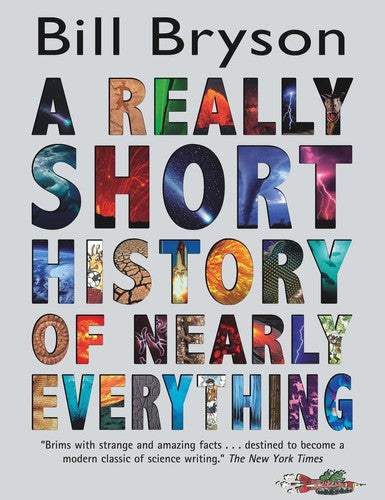
A Really Short History of Nearly Everything
What do the conditions mean?
Our conditions mean the following:
- New - a brand new book
- Almost New - appears new but is actually secondhand.
- Very Good - only minor imperfections such as minor scuffs to edge or cover or a price written in pencil or shop sticker.
- Standard Secondhand - Clearly been read before, but not too bad. We do not recommend these for gifting. Spines usually creased. Could also include creases or folds to cover, some writing such as in the cover or elsewhere, underlining or highlighting, but might not do. Possibly some stains or marks. Similar in general to books in any secondhand shop or charity shop.
- Poor Condition - Usually this will have a specific problem such as writing inside, water damage, missing dust jacket, heavy staining, large creases or cuts. These are readable copies but not nice ones. On other websites this condition is called 'Acceptable' or 'Fair' , but we want to be more honest.
Low stock: 1 left
Bill Bryson’s own fascination with science began with a battered old school book he had when he was about ten or eleven years old. It had an illustration that captivated him–a diagram showing Earth’s interior as it would look if you cut into it with a large knife and removed about a quarter of its bulk. The idea of lots of startled cars and people falling off the edge of that sudden cliff (and 4,000 miles is a pretty long way to fall) was what grabbed him in the beginning, but gradually his attention turned to what the picture was trying to teach him: namely that Earth’s interior is made up of several different layers of materials, and at the very centre is a glowing sphere of iron and nickel,
as hot as the Sun’s surface, according to the caption. And he very clearly remembers thinking: “How do they know that?”
Bill’s storytelling skill makes the “How?” and, just as importantly, the “Who?” of scientific discovery entertaining and accessible for all ages. He covers the wonder and mystery of time and space, the frequently bizarre and often obsessive scientists and the methods they used, and the mind-boggling fact that, somehow, the universe exists and against all odds, life came to be on this wondrous planet we call home.


Genre: Children's non-fiction, Science & Nature
Format: Hardback
Published: 2008
Pages: 176
Publisher: National Geographic Books
ISBN: 9780385666862
Payment method
Condition Descriptions
Our conditions mean the following:
- New - a brand new book
- Almost New - appears new but is actually secondhand.
- Very Good - only minor imperfections such as minor scuffs to edge or cover or a price written in pencil or shop sticker.
- Standard Secondhand - Clearly been read before, but not too bad. We do not recommend these for gifting. Spines usually creased. Could also include creases or folds to cover, some writing such as in the cover or elsewhere, underlining or highlighting, but might not do. Possibly some stains or marks. Similar in general to books in any secondhand shop or charity shop.
- Poor Condition - Usually this will have a specific problem such as writing inside, water damage, missing dust jacket, heavy staining, large creases or cuts. These are readable copies but not nice ones. On other websites this condition is called 'Acceptable' or 'Fair' , but we want to be more honest.
Shipping and Delivery
- Free UK shipping over £10.
- Under £10, shipping is £1.99.
- Express shipping £2.99.
- Choose 10 £1 books for £10 including shipping!
- International shipping available to select countries, proceed to checkout to see prices.
Return
Return books within 14 days if not happy.
More £1 children’s books
All £1 books →-

-

-

-
 by Dr Richard Parsons
KS2 Maths Study Book - Ages 7-11 (CGP KS2 Maths), 29.5 cm
From £1.00From £1.00 -

Where's Spidey?: A Marvel Spider-Man Search & Find Book
From £1.00From £1.00 -


