


Cover may vary - this is a stock image
Electronic Devices
Format: Hardback
Other edition in stock
What do the conditions mean?
Our conditions mean the following:
- New - a brand new book
- Almost New - appears new but is actually secondhand.
- Very Good - only minor imperfections such as minor scuffs to edge or cover or a price written in pencil or shop sticker.
- Standard Secondhand - Clearly been read before, but not too bad. We do not recommend these for gifting. Spines usually creased. Could also include creases or folds to cover, some writing such as in the cover or elsewhere, underlining or highlighting, but might not do. Possibly some stains or marks. Similar in general to books in any secondhand shop or charity shop.
- Poor Condition - Usually this will have a specific problem such as writing inside, water damage, missing dust jacket, heavy staining, large creases or cuts. These are readable copies but not nice ones. On other websites this condition is called 'Acceptable' or 'Fair' , but we want to be more honest.
Low stock: 1 left
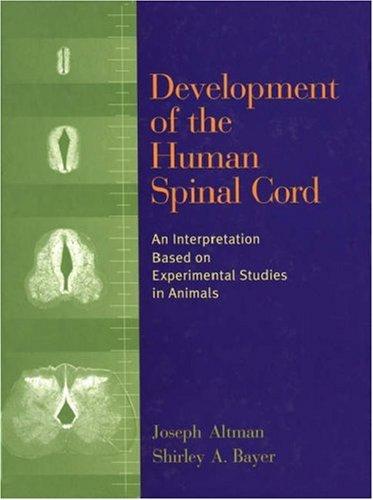
There exists a wealth of information about the development of the spinal cord in journal articles and monographs, yet this beautifully illustrated work is the first book devoted to this important topic. Because the developing human spinal cord cannot be subjected to experimental manipulations, the knowledge gained from experimental work in animals is applied here to an interpretation of the time course and mechanisms of spinal cord development in man. The book begins with a review of our current understanding of the structure and functions of the spinal cord. Special reference is made to the phylogeny of the vertebrate spinal cord because the authors' interpretation of the development and organization of the human spinal cord is specifically an evolutionary one. Following a detailed experiment-based account of spinal cord development in the rat, the development of the human spinal cord is described, illustrated and interpreted in separate chapters during three epochs: the first trimester (the embryonic period), the second and third trimesters (the fetal period), and the first year of postnatal life. Special attention is paid to such topics as neurons, and the growth and myelination of the ascending and descending fiber tracts of the spinal cord. The book ends with a correlation of the development of motor behavior with different stages in the morphological development of the human spinal cord during the embryonic, fetal, and postnatal periods. The successive acquisition of voluntary control over different parts of the body during infancy is correlated with the progressive myelination of the corticospinal tract.
* The book contains an extensive review of work on spinal cord organization and development throughout the 20th century.
* The interpretations are based on experimental studies of spinal cord development in the rat carried out by the authors and their associates.
* The histological material on human spinal cord development is the largest ever assembled and reproduced (combining the Carnegie, Minot, and Yakovlev Collections).
* The collected material (which varies in quality and some of it has begun to fade) has been digitized and electronically reprocessed for improved reproduction.
* Discrete components of the spinal cord and new developments are highlighted by color coding; typically on one side only, leaving the contralateral side untouched to allow the reader to use his own interpretation.
* Summary graphs are presented, many in color, to convey important structural relationships, developmental events, or theories.
* The authors revive a few forgotten theories and offer several new ones regarding the development and organization of the human spinal cord.
Development of the Human Spinal Cord will be of interest to developmental biologists, neuroscientists, embryologists, molecular biologists (those working on stem cell research), pediatric neurologists, pathologists, child and developmental psychologists, and their students and trainees.


Genre: Medical, Neurology
Format: Paperback
Published: 2001
Pages: 542
Publisher: Oxford University Press
ISBN: 9780195144277
Payment method
Condition Descriptions
Our conditions mean the following:
- New - a brand new book
- Almost New - appears new but is actually secondhand.
- Very Good - only minor imperfections such as minor scuffs to edge or cover or a price written in pencil or shop sticker.
- Standard Secondhand - Clearly been read before, but not too bad. We do not recommend these for gifting. Spines usually creased. Could also include creases or folds to cover, some writing such as in the cover or elsewhere, underlining or highlighting, but might not do. Possibly some stains or marks. Similar in general to books in any secondhand shop or charity shop.
- Poor Condition - Usually this will have a specific problem such as writing inside, water damage, missing dust jacket, heavy staining, large creases or cuts. These are readable copies but not nice ones. On other websites this condition is called 'Acceptable' or 'Fair' , but we want to be more honest.
Shipping and Delivery
- Free UK shipping over £10.
- Under £10, shipping is £1.99.
- Express shipping £2.99.
- Choose 10 £1 books for £10 including shipping!
- International shipping available to select countries, proceed to checkout to see prices.
Return
Return books within 14 days if not happy.
More £1 non-fiction
All £1 books →-
 by Malcolm Gladwell
Talking to Strangers: What We Should Know about the People We Don’t Know
From £1.00From £1.00 -
 by Reni Eddo-Lodge
Why I’m No Longer Talking to White People About Race: The #1 Sunday Times Bestseller
£1.00£1.00 -
 by Thomas Halliday
Otherlands: A World in the Making - A Sunday Times bestseller
From £1.00From £1.00 -
 by Yuval Noah Harari
Sapiens: A Brief History of Humankind: The multi-million copy bestseller
From £1.00From £1.00 -

-
 by Aubrey Penning
Elements of Costing Tutorial (AAT Foundation Certificate in Accounting)
£1.00£1.00


