


Cover may vary - this is a stock image
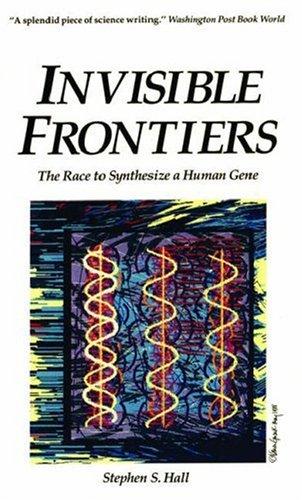
Invisible FrontiersThe Race to Synthesize a Human Gene
Format: Paperback
What do the conditions mean?
Our conditions mean the following:
- New - a brand new book
- Almost New - appears new but is actually secondhand.
- Very Good - only minor imperfections such as minor scuffs to edge or cover or a price written in pencil or shop sticker.
- Standard Secondhand - Clearly been read before, but not too bad. We do not recommend these for gifting. Spines usually creased. Could also include creases or folds to cover, some writing such as in the cover or elsewhere, underlining or highlighting, but might not do. Possibly some stains or marks. Similar in general to books in any secondhand shop or charity shop.
- Poor Condition - Usually this will have a specific problem such as writing inside, water damage, missing dust jacket, heavy staining, large creases or cuts. These are readable copies but not nice ones. On other websites this condition is called 'Acceptable' or 'Fair' , but we want to be more honest.
Low stock: 1 left
From the spring of 1976 to the fall of 1978, three laboratories competed in a feverish race to clone a human gene for the first time, a feat that ultimately produced the world's first genetically engineered drug--the life-sustaining hormone insulin. Invisible Frontiers gives us a behind-the-scenes look at the three main groups at Harvard University, the University of California-San Francisco, and a team of upstart scientists at Genentech, the first company devoted to the use of genetic engineering in the creation of pharmaceuticals. When the dust had settled, one scientist had won a Nobel Prize, many others had become biotech's first millionaires, and the key technologies were in place that set the stage for the human genome project. Author Stephen Hall weaves together the scientific, social and political threads of this story--the fierce rivalry between labs, the fateful clash of egos within labs, the invasion of academia by commerce, the public fears about genetic engineering, the threat of government regulation, and the ultimate triumph of modern biology--to give us an outstanding tale of scientific research.
In this fast-paced, gripping narrative Hall captures the highlights--and high jinks--of one of the greatest eras in recent biological history: the discovery of recombinant DNA and the birth of biotechnology.


Genre: Medical, Pharmacology
Format: Paperback
Published: 2002
Pages: 334
Publisher: Oxford University Press
ISBN: 9780195151596
Payment method
Condition Descriptions
Our conditions mean the following:
- New - a brand new book
- Almost New - appears new but is actually secondhand.
- Very Good - only minor imperfections such as minor scuffs to edge or cover or a price written in pencil or shop sticker.
- Standard Secondhand - Clearly been read before, but not too bad. We do not recommend these for gifting. Spines usually creased. Could also include creases or folds to cover, some writing such as in the cover or elsewhere, underlining or highlighting, but might not do. Possibly some stains or marks. Similar in general to books in any secondhand shop or charity shop.
- Poor Condition - Usually this will have a specific problem such as writing inside, water damage, missing dust jacket, heavy staining, large creases or cuts. These are readable copies but not nice ones. On other websites this condition is called 'Acceptable' or 'Fair' , but we want to be more honest.
Shipping and Delivery
- Free UK shipping over £10.
- Under £10, shipping is £1.99.
- Express shipping £2.99.
- Choose 10 £1 books for £10 including shipping!
- International shipping available to select countries, proceed to checkout to see prices.
Return
Return books within 14 days if not happy.
More £1 history books
All £1 books →-
 by IanRussell McEwan
Atonement: Discover the modern classic that has sold over two million copies.
From £1.00From £1.00 -
 by Andrea Levy
The Long Song: Shortlisted for the Man Booker Prize 2010: Shortlisted for the Booker Prize
£1.00£1.00 -
 by Pankhurst Helen
We Are Feminist: An Infographic History of the Women's Rights Movement
From £1.00From £1.00 -

-
 by Tracy Chevalier
A Single Thread: Dazzling new fiction from the globally bestselling author of Girl With A Pearl Earring
From £1.00From £1.00 -


