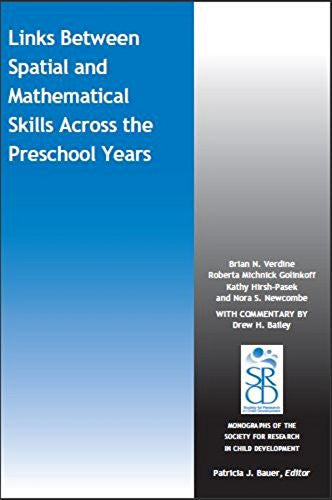
Cover may vary - this is a stock image
Link between Spatial and Mathematical Skills across the Preschool Years
Low stock: 1 left
Understanding the development of spatial skills is important for improving overall success in STEM (science, technology, engineering, and mathematics) fields (e.g., Wai, Lubinski, Benbow, & Steiger, 2010). Children use spatial skills to understand the world and can practice them via spatial assembly activities like puzzles or blocks. These skills have been linked to success in subjects like mathematics (Mix & Cheng, 2012) and science (Pallrand & Seeber, 1984; Pribyl & Bodner, 1987). This monograph sought to answer four questions about early spatial development: 1) Can we reliably measure spatial skills in 3- and 4-year-olds?; 2) Do spatial skills measured at 3 predict spatial skills at age 5?; 3) Do preschool spatial skills predict mathematics skills at age 5?; and 4) What factors contribute to individual differences in preschool spatial skills (e.g., SES, gender, fine-motor skills, vocabulary, and executive function)? Longitudinal data generated from a new spatial skill test for 3-year-old children, called the TOSA (Test of Spatial Assembly), show that it is a reliable and valid measure of early spatial skills that provides strong prediction to spatial skills measured with established tests at age 5. New data using this measure finds links between early spatial skill and mathematics, language, and executive function skills. Analyses suggest that preschool spatial experiences may play a central role in early mathematical skills. Executive function skills further predict mathematical performance and individual differences, specifically socio economic status, are related to spatial and mathematical skill. We conclude by exploring ways of providing rich early spatial experiences.
Format: Paperback
Published: 2017
Pages: 150
Publisher: Wiley
ISBN: 9781119402503
Share
Payment method
Condition Descriptions
Our conditions mean the following:
- New - a brand new book
- Almost New - appears new but is actually secondhand.
- Very Good - only minor imperfections such as minor scuffs to edge or cover or price price written in pencil or shop sticker.
- Standard Secondhand - Clearly been read before, but not too bad. We do not recommend these for gifting. Spines usually creased. Could also include creases or folds to cover, some writing such as in the cover or elsewhere, underlining or highlighting, but might not do. Possibly some stains or marks. Similar in general to books in any secondhand shop or charity shop.
- Poor Condition - Usually this will have a specific problem such as writing inside, water damage, missing dust jacket, heavy staining, large creases or cuts. These are readable copies but not nice ones. On other websites this condition is called 'Acceptable' or 'Fair' , but we want to be more honest.
Shipping and Delivery
- Free UK shipping over £10.
- Under £10, shipping is £1.99.
- Express shipping £2.99.
- Choose 10 £1 books for £10 including shipping!
- International shipping available to select countries, proceed to checkout to see prices.
Return
Return books within 14 days if not happy.
Share