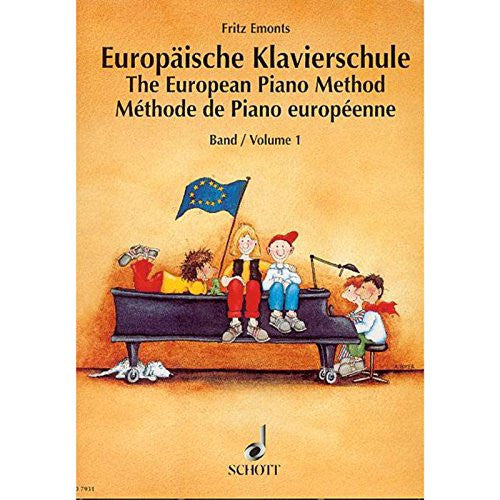
Cover may vary - this is a stock image
The European Piano Method - Volume 1German/French/English Book with Online Audio
Format: Paperback
What do the conditions mean?
Our conditions mean the following:
- New - a brand new book
- Almost New - appears new but is actually secondhand.
- Very Good - only minor imperfections such as minor scuffs to edge or cover or a price written in pencil or shop sticker.
- Standard Secondhand - Clearly been read before, but not too bad. We do not recommend these for gifting. Spines usually creased. Could also include creases or folds to cover, some writing such as in the cover or elsewhere, underlining or highlighting, but might not do. Possibly some stains or marks. Similar in general to books in any secondhand shop or charity shop.
- Poor Condition - Usually this will have a specific problem such as writing inside, water damage, missing dust jacket, heavy staining, large creases or cuts. These are readable copies but not nice ones. On other websites this condition is called 'Acceptable' or 'Fair' , but we want to be more honest.
Low stock: 1 left
(Schott). Following the very successful piano method published in two volumes between 1958 and 1962, the three-volume "European Piano Method" represents a new textbook which takes into account the development of modern piano pedagogy. Winning features of the Emonts Method: songs from many European countries, pupils begin to play without music notation, improvisation and playing on the black keys, development of listening skills and aural awareness, simple and logical learning structure, lots of duets, and attractive full-colour illustrations. Volume 1: The most natural way of creating and nurturing the relationship of a child with an instrument is to stimulate and encourage the child to find on the keyboard, and to play by ear, all the tunes he or she has so far assimilated. Not only children's songs or folk songs are suitable for this but also other melodies that may be heard at home, at school, in church, on the radio and on television. The natural progression, from singing and listening to playing, forms the foundation for the development of listening ability and musicality. During a lifetime with an instrument one should always try to replay on it everything that one has heard. The child should, at the same time, be made familiar with the whole keyboard by touch as well as by ear, from the lowest register to the highest. the young player should already have a feeling of contact with the keyboard before piano playing is combined with the complicated process of reading music. Playing only on the black keys to begin with will offer a particularly good opportunity to grasp the arrangements of the black keys (literally) 'grasping'. For improvised melodies, too, the pentatonic scale formed by the black keys is easier to handle at the beginning stages than the diatonic scale of the white keys. For this reason, an introductory section 'Playing with the Black Keys' has been included. Here the teacher, through such material, should encourage the beginner to become familiar with the keyboard. Another advantage in beginning this way lies in the fact that training the functions of the motorial system does not only start within the narrow stretch of the fingers but with the larger playing apparatus of the arms and the whole body. In this way tension can be avoided. The suggestions for improvisation and song accompaniement given at the beginning (on the 'yellow' pages) should not necessarily be dealt with all at once before the chapter 'Playing from Printed Music' but should rather be gradually incorporated into lessons. Here, the printed music is intended primarily for the teacher who will play through the exercises. The pupil plays from memory rather than from the book. Audio is accessed online.
Format: Sheet Music
Published: 1992
Pages: 88
Publisher: Schott
ISBN: 9783795750022
Share
Payment method
Condition Descriptions
Our conditions mean the following:
- New - a brand new book
- Almost New - appears new but is actually secondhand.
- Very Good - only minor imperfections such as minor scuffs to edge or cover or a price written in pencil or shop sticker.
- Standard Secondhand - Clearly been read before, but not too bad. We do not recommend these for gifting. Spines usually creased. Could also include creases or folds to cover, some writing such as in the cover or elsewhere, underlining or highlighting, but might not do. Possibly some stains or marks. Similar in general to books in any secondhand shop or charity shop.
- Poor Condition - Usually this will have a specific problem such as writing inside, water damage, missing dust jacket, heavy staining, large creases or cuts. These are readable copies but not nice ones. On other websites this condition is called 'Acceptable' or 'Fair' , but we want to be more honest.
Shipping and Delivery
- Free UK shipping over £10.
- Under £10, shipping is £1.99.
- Express shipping £2.99.
- Choose 10 £1 books for £10 including shipping!
- International shipping available to select countries, proceed to checkout to see prices.
Return
Return books within 14 days if not happy.
Share